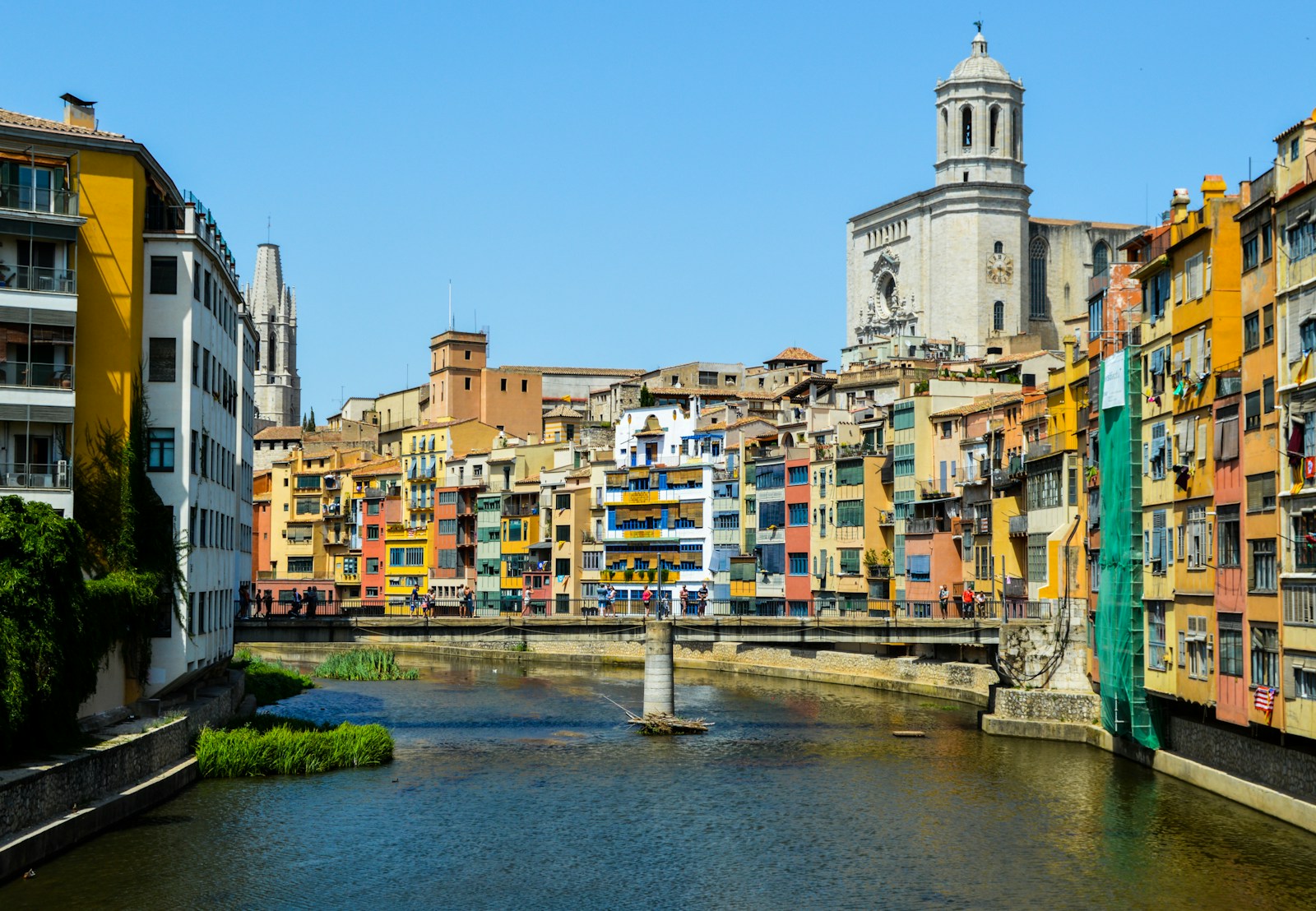
Girona is substantial enough to feel like a journey, yet compact enough for a day without transfers once you arrive. Fast and regional trains connect it with Barcelona, and the station sits within walking distance of the historic centre. The change of scene begins at the River Onyar: colourful façades, footbridges and cathedral towers layered behind them.
This route moves gradually uphill through the old city, then uses the walls for a final change of perspective. It is deliberately selective. Girona has excellent museums, churches and restaurants, but one well-paced day is better served by understanding its shape than by collecting entrances.
Cross into the old city
The Onyar bridges and Rambla de la Llibertat
Approach the river through the newer city and cross more than once. Each footbridge rearranges the view of the Onyar houses, with the old quarter rising behind them. The bright red Pont de les Peixateries Velles is the most recognisable crossing, but quieter bridges often give the better photograph of it. On the east bank, Rambla de la Llibertat introduces Girona at street level through arcades, shops and café tables. Pause here rather than postponing every break until after the monuments; the old town becomes steeper from this point.
Plan your visitThe Cathedral and Força Vella
The cathedral's broad staircase announces the building long before the interior. Inside, Romanesque, Gothic and Baroque elements record centuries of construction, while the cloister and museum add quieter spaces beyond the famous nave. Check visiting access against worship before the day, particularly on Sundays and religious dates. Outside, resist returning immediately down the same steps. The surrounding Força Vella follows the footprint of Girona's Roman foundation, and its sloping lanes reveal fragments of the fortified city with fewer visitors than the principal approach.
Plan your visitRead the streets, then climb above them
The Call and Museum of Jewish History
Girona's Call is a dense network of narrow passages, stairs and small courtyards shaped by the Jewish community that lived here in the Middle Ages. It should not be treated merely as an atmospheric backdrop. The Museum of Jewish History, housed within the former Jewish quarter, provides essential context through archaeological objects, documents and the story of Catalonia's Jewish communities. Give the museum a proper hour if you enter, and keep voices low in the surrounding lanes, which remain part of a lived neighbourhood rather than an outdoor set.
Plan your visitPasseig de la Muralla
Finish above the roofs on the restored stretches of Girona's walls. Access points let you walk only part of the circuit, so there is no need to complete every section. Towers open wider views across the cathedral, Sant Feliu, the old city and the green land beyond; the changing angle makes the climb more interesting than a single lookout. Steps and uneven surfaces are integral to the route, and exposure to sun or rain is greater than in the lanes below. Descend before you are tired, then return to the station through the city at a gentler pace.
Plan your visitBefore you go
Compare current train schedules and ticket conditions through the official rail operator, noting that services differ in journey time and reservation requirements. Buy a specific fast-train ticket in advance when needed, but preserve flexibility elsewhere. Girona's stone can be slippery after rain and the old quarter includes sustained slopes and stairs; comfortable footwear matters. Verify cathedral, museum and wall access on the official sites, leave room for lunch, and plan to reach the station well before departure rather than turning the final descent into a race.