The Sagrada Família and the Recinte Modernista de Sant Pau stand within a short walk of one another, linked by the diagonal line of Avinguda de Gaudí. They were created by different architects for different purposes, yet together they show how Modernisme could make faith, public life, craft and new forms of engineering visible.
Give the pair most of a day rather than inserting them between unrelated sights. The basilica asks for a fixed entry time and close attention; Sant Pau rewards an unhurried route through pavilions and gardens. The avenue between them is the natural place to reset, look back at the towers and allow one architectural world to settle before entering another.
Although both complexes are celebrated as landmarks, they remain connected to living institutions: worship continues at the basilica, while the wider Sant Pau campus carries a long history of healthcare and now supports cultural and knowledge projects. That context calls for more than a façade photograph. Read the visitor rules, respect areas outside the public route and notice how each architect used natural forms without producing anything remotely alike.
Let the basilica unfold in stages
The Nativity and Passion façades
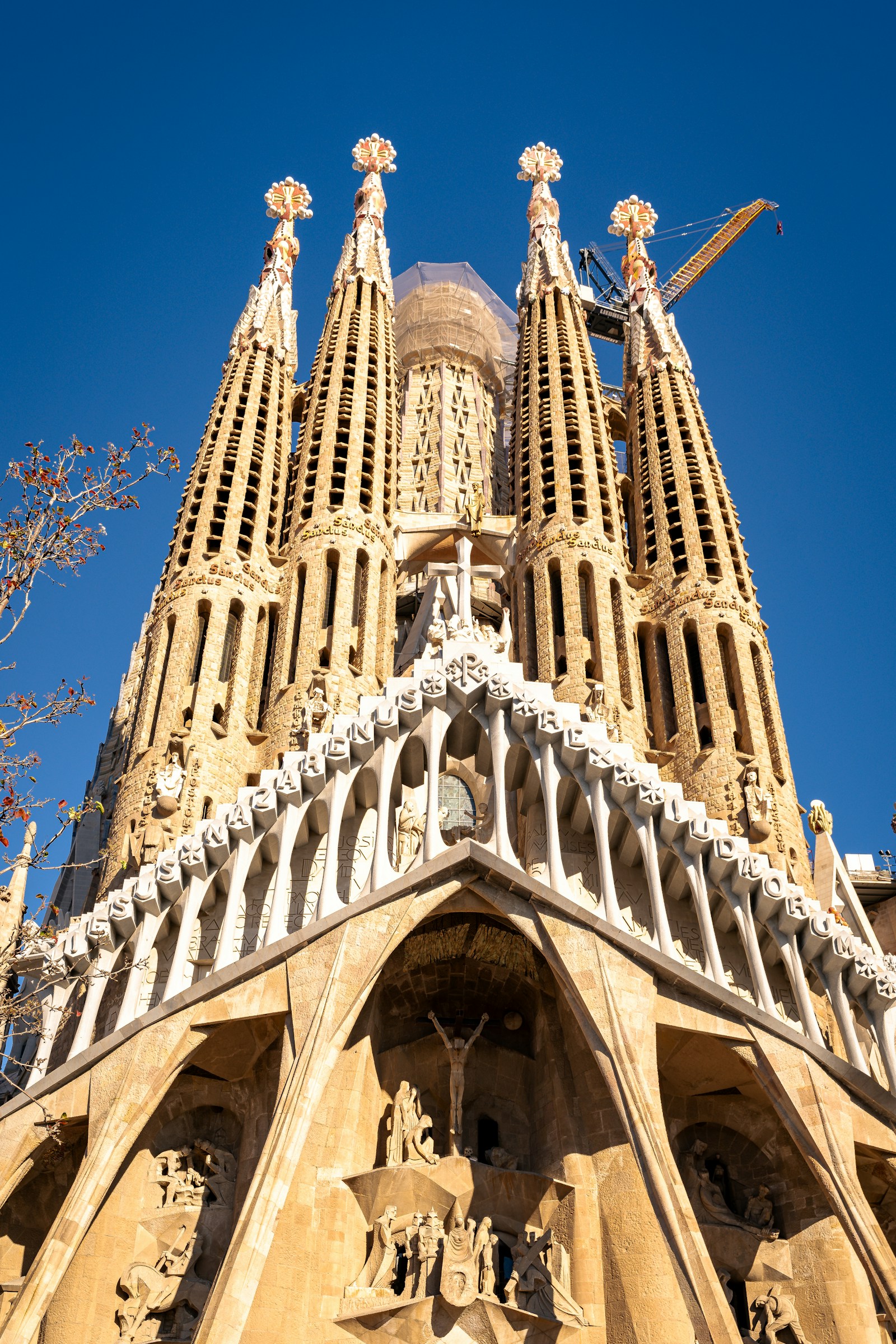
Arrive early enough to walk around the building before your time slot. The Nativity façade is dense with plant, animal and human forms, its surface constructed as a celebration of life. On the opposite side, the Passion façade is more severe, with spare geometry and dramatic sculptural groups. Seeing both clarifies that the basilica is not designed to have one principal face. Construction and access routes evolve, so follow the entrance named on your ticket rather than relying on an old map. The surrounding pavements are busy; step into the adjacent squares when open to gain distance and a more legible view.
Plan your visitThe basilica interior and museum
Inside, the forest-like columns are not decoration applied to a conventional church: their branching structure organises the building and directs the eye upward. Coloured light changes with the hour and weather, which is reason enough to resist treating the nave as a passage to the next photograph. Use the official audioguide if it helps you slow down, and bring the headphones and charged phone it requires. Before leaving, visit the museum to understand the models, geometry and continuing construction. Tower admission is a separate choice with specific mobility and weather conditions; select it intentionally rather than as an automatic upgrade.
Plan your visitContinue along Avinguda de Gaudí
Recinte Modernista de Sant Pau
Walk northeast until Domènech i Montaner's Administration Pavilion closes the avenue's perspective. Sant Pau was conceived as a hospital campus of individual pavilions set among gardens, joined by underground galleries. A self-guided route introduces the former clinical spaces, decorative programmes and the belief that light, air, colour and nature belonged within a place of care. The scale is generous after the basilica, and benches in the gardens encourage a different rhythm. Some spaces may close for events, so consult the current route; the visit remains worthwhile even when the exact sequence changes.
Look particularly at the relationship between ornament and orientation. Distinctive materials and motifs gave the pavilions individual identities, while the gardens created light and separation between clinical spaces. The Administration Pavilion provides the grandest interiors, but the quieter pleasure is moving between buildings and seeing the complex as a planned whole rather than a collection of decorative façades.
Plan your visitBefore you go
Buy Sagrada Família tickets only through the official site or app and treat the named entry time as fixed; late arrival may mean losing access. Sant Pau can then sit before or after it according to current opening information. Both sites are active institutions with security and visitor rules, and neither experience benefits from heavy luggage. Bring headphones, charge your phone, check tower and garden conditions, and leave the avenue between the two unscheduled enough for a coffee or a quiet look back.