Barcelona's museums do not collapse neatly into a single must-see list. Their collections inhabit very different buildings and neighbourhoods, and choosing one can shape the whole day around it. The useful question is not which museum is universally best, but whether you want an artist's development, an encounter between art and landscape, or a conversation with the present.
These three choices are deliberately distinct. The Museu Picasso fills medieval palaces in El Born; the Fundació Joan Miró was conceived with the artist as a luminous home for his work on Montjuïc; MACBA places contemporary exhibitions against the civic theatre of Plaça dels Àngels. Read the current exhibition pages as carefully as the permanent-collection descriptions, then give your choice room to breathe.
Location can make the decision easier. Picasso pairs naturally with a walk through El Born and the medieval city. Miró belongs to a slower Montjuïc day with gardens, viewpoints or another cultural stop. MACBA opens onto El Raval and the centre's independent bookshops and galleries. Let the museum anchor its neighbourhood rather than crossing Barcelona simply to add another famous name to the same afternoon.
For biography and the making of an artist
Museu Picasso Barcelona
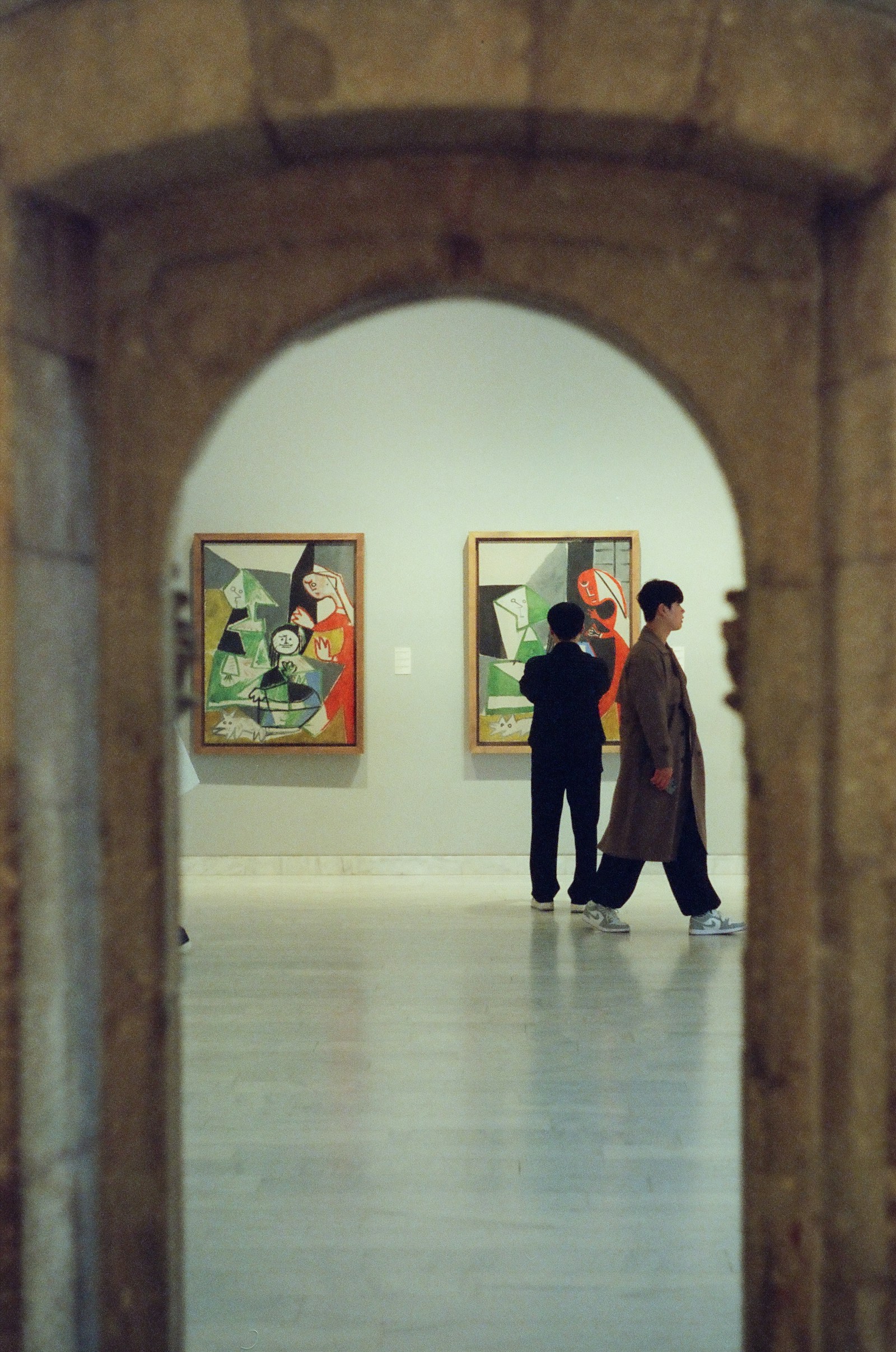
Choose the Museu Picasso if you are curious about how an artist develops rather than looking only for the images reproduced most often. The collection has particular depth in Picasso's early years and his relationship with Barcelona, making youthful experiments, academic studies and later returns to earlier masters part of a coherent story. The setting—five adjoining medieval palaces—adds architectural rhythm but also stairs, courtyards and a linear route. Timed admission is sensible, especially when a temporary exhibition shares capacity. Review the museum's current highlights beforehand and arrive with one question rather than an obligation to absorb thousands of works.
Plan your visitFor colour, space and a view over the city
Fundació Joan Miró
Choose the Fundació Miró when the relationship between art and architecture matters as much as chronology. Miró worked with architect Josep Lluís Sert to imagine a building of white volumes, courtyards, terraces and natural light, where pauses are built into the route. The collection establishes Miró's language across media while temporary exhibitions keep the institution connected to younger and contemporary practices. Its Montjuïc location turns the visit into half a day rather than an isolated indoor appointment. Approach by public transport, then keep time for the patios and views instead of hurrying straight back downhill.
Plan your visitFor the city as it is now
MACBA
Choose MACBA when you want questions rather than a single historical narrative. Its programme is exhibition-led, so the experience changes meaningfully through the year; looking at what is actually on view is essential before deciding. Richard Meier's bright building faces Plaça dels Àngels, where skaters, students and neighbours create an unofficial public counterpart to the galleries inside. Contemporary work may be demanding, but the museum provides digital guidance, visits and places to sit. Give yourself permission to follow one exhibition deeply and leave another quickly—the visit is a conversation, not a test.
Plan your visitBefore you go
Check each museum's official calendar for closing days, temporary exhibitions, renovation notices and timed-entry requirements; these details change more often than guidebook summaries. Avoid combining all three in one day: they occupy different neighbourhoods and ask for different kinds of attention. Small bags make security and cloakroom rules easier, while headphones are useful for digital guides. If accessibility, family resources or a quiet visiting time matters, use the detailed visitor pages or contact the museum directly before booking.